
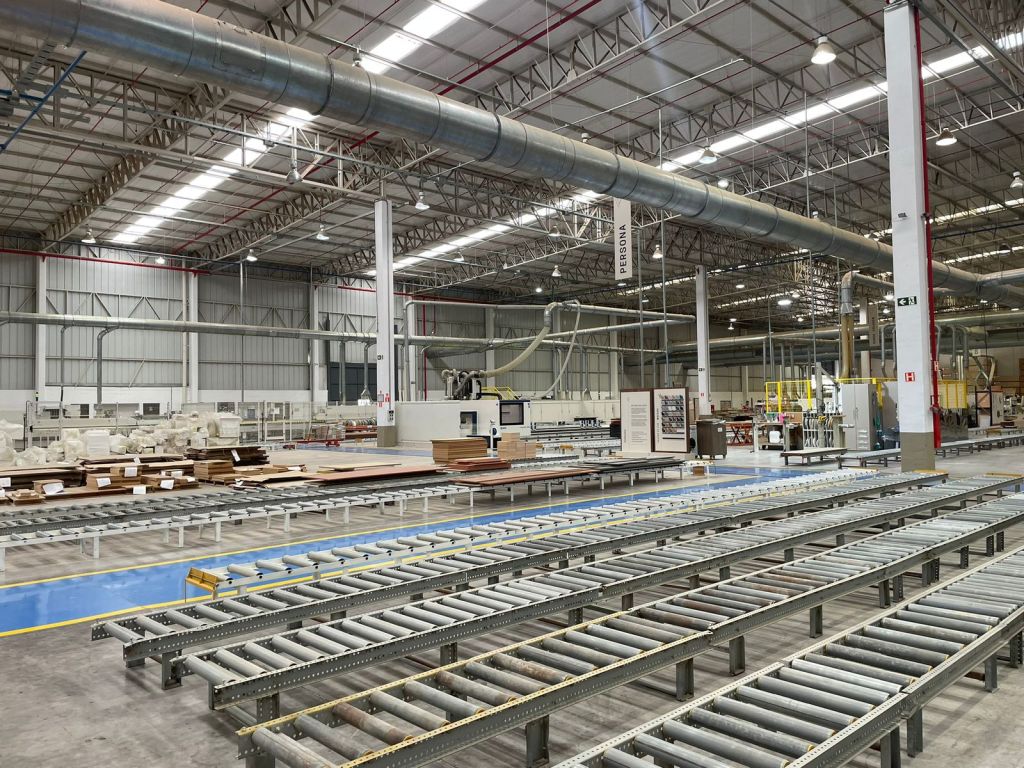
Vista Furniture Co. connects international retailers with Brazilian manufacturers like this, managing product development, quality control, and export logistics from start to finish.
#VistaFurnitureCo #BrazilianFurniture #FurnitureSourcing #FurnitureManufacturing #BrazilianDesign
Why Brazil, and why now
Vista Furniture Co. was built for one job: help global buyers develop and scale furniture collections from Brazil with operational clarity, supplier discipline, and export-ready execution.
Brazil sits in a rare intersection for furniture importers:
- A large industrial base with mature clusters (especially in the South).
- Strong woodworking know-how, upholstery capacity, and a growing design culture.
- Competitive labor and material economics versus many “traditional” exporting regions.
- A supplier landscape that ranges from high-volume OEM to design-driven, higher-end factories.
But here’s the truth that experienced buyers already know: Brazil can be a margin win or a costly distraction. The difference is process. The goal of this guide is to make the process predictable, the risks manageable, and the outcomes repeatable.
If you are a sourcing manager, a private-label buyer at a retail chain, or a design-led importer supplying premium stores, the playbook is the same:
- choose the right suppliers,
- lock specs and packaging,
- run quality control with teeth,
- ship with correct documents and compliance,
- build a system you can repeat every quarter.
1) Start with the business model, not the product
Before you contact factories, define the import model. It changes everything.
Three common models
A) Private label / OEM
- You own the brand and product spec.
- Factory produces to spec.
- Best for large retailers and marketplaces.
B) White label (factory catalog)
- Faster, cheaper development.
- Good for initial pilots or filling assortments.
C) Exclusive capsule
- Semi-custom, differentiated finishes, fabrics, dimensions.
- Great for premium retailers and design-focused brands.
Importer reality check: If you want scale, prioritize products that are export-friendly:
- knock-down where possible,
- fewer SKUs per family,
- controlled material variability,
- repeatable finishes,
- packaging built for e-commerce handling (even if you ship wholesale).
2) Supplier selection in Brazil: what matters more than price
Brazil has excellent manufacturers. It also has factories that look great on Instagram and fail at basic export discipline. Your shortlist should be driven by capability evidence.
The shortlist criteria that actually predict success
Export maturity
- Can they produce consistent documentation, packing lists, and labeling?
- Do they understand delivery windows and penalties?
Process and QC culture
- Are there in-line checks or only “final inspection by hope”?
- Do they measure critical points (wood moisture, joint strength, foam density, carton specs)?
Packaging competence
- They must design packaging for container plus last-mile, especially if your channel is e-commerce.
- A “pretty carton” is not a safe carton.
Engineering and repeatability
- Can they support drawings, BOM discipline, revision control, and versioning?
Communication speed
- In sourcing, speed is risk reduction.
Pro tip: Ask for proof of prior export shipments and destinations. Not a story. Proof.
3) Sampling: the fastest way to burn money (if you do it wrong)
Sampling is not “let’s see if it looks good.” Sampling is pre-production validation.
What a proper sampling cycle includes
- Golden spec pack
- dimensions with tolerances
- materials and finishes
- hardware list
- assembly method
- packaging method and protections
- Pre-production sample
- Packaging validation
- drop tests and protection review
- Assembly UX check
- time-to-assemble, missing tools, confusion points
- Revision control
- version A, B, C with documented changes
If you skip packaging validation, you are effectively accepting a future returns tax.
4) Packaging: your hidden profit lever
For marketplace operators, packaging is not a detail. It is cost of returns, damage rate, warehouse handling time, and customer satisfaction.
A serious packaging standard considers:
- container loading and stacking
- corner and edge protection
- foam strategy and scratch prevention
- drop test heights by carton weight
- environmental requirements and restricted substances in packaging components
Many global buyers require packaging aligned to ISTA 3A-style testing logic and minimum carton strength metrics for corrugate. Mail order packaging standard
What to demand from suppliers (minimum)
- Double-wall corrugate aligned to weight class
- Corner protection (especially for tables, casegoods, sofas)
- No internal movement
- Clear labeling and barcode placement logic
- Manual packaged correctly, with the correct language set for destination markets Mail order packaging standard
If you sell DTC or via a marketplace, assume cartons will be dropped. Design accordingly.
5) Incoterms and landed cost: get this wrong and your spreadsheet lies
Incoterms define who pays, who insures, and where risk transfers. They do not replace a contract, but they prevent chaos.
Most furniture import programs operate with:
- EXW (buyer controls export logistics and pickup)
- FOB (supplier delivers to port and clears export)
- CIF/CFR (supplier books ocean freight, buyer handles insurance or local steps depending on term)
- DDP (rare for furniture unless you have a specialized setup)
Use Incoterms 2020 as the standard reference. ICC – International Chamber of Commerce
A practical recommendation
- If you are early-stage importing from Brazil, FOB is often the cleanest operational split.
- If you have strong forwarders and want control, EXW can work, but demands more local coordination.
Margin tip: Build landed cost with conservative buffers:
- damages/returns
- demurrage risk
- inspection costs
- packaging upgrades
- compliance testing and labeling
6) Compliance: US and EU are not forgiving anymore
This is where many “cheap” programs become expensive.
United States: key areas for furniture
A) Lacey Act (wood declaration requirements)
If your product contains plant material and falls under certain listed HTS codes and formal entry conditions, you may need to file a Lacey Act declaration. APHIS
Even when a declaration is not required for a specific entry type, the prohibition on trading illegally sourced wood remains a serious risk area for wood products, including furniture. Timber Trade Portal
B) TSCA Title VI (formaldehyde emissions for composite wood)
Composite wood panels and finished goods containing them (like many MDF/particleboard furniture pieces) must meet TSCA Title VI requirements, with TSCA-compliant labeling after the relevant transition dates. US EPA+1
If you sell into California or you want to align with the most common US expectations, be aware of CARB-related composite wood standards and consumer-facing compliance logic. Conselho de Recursos do Ar da Califórnia
European Union: two major moving pieces
A) GPSR (General Product Safety Regulation)
The EU’s GPSR (Regulation (EU) 2023/988) applies from 13 December 2024. GOV.UK+1
Even if furniture is not “high-tech,” you need traceability discipline, warnings where relevant, and documentation readiness.
B) EUDR (EU Deforestation Regulation)
The EU deforestation law timeline has shifted. Reuters reported EU approval of a one-year delay, with large companies required to comply from 30 December 2026, and smaller firms later. Reuters
The regulation itself is Regulation (EU) 2023/1115 and is designed to reduce EU-linked deforestation impacts. Environment
What this means for Brazil furniture exporters/importers: if your product includes wood, you should start building traceability and documentation habits now, not in the quarter you plan to ship.
7) Documentation: don’t let paperwork become a cargo hold
Furniture imports fail quietly in paperwork.
At minimum, expect:
- Commercial invoice
- Packing list
- Bill of lading
- Certificate of origin (when needed)
- Product labeling and manuals (language and regulatory marks where applicable)
- Material declarations when required by your market or retailer program
On the Brazil side, exporting runs through official systems like Portal Único Siscomex, and your supplier or exporter-of-record must be operationally capable here. Portal Único Siscomex+1
8) Quality control: do not “inspect quality into the product”
Quality is built, not discovered. But inspections are still essential.
The inspection structure that works
1) Pre-production alignment
- approve golden sample
- confirm packaging spec
- confirm labeling and manuals
2) In-process inspection
- catch issues early: finish consistency, hardware, foam, moisture, carton prep
3) Final random inspection
- AQL-style sampling
- carton drop test checks if applicable
- photo evidence, measurement evidence
4) Container loading supervision
- loading pattern, protection, moisture risk mitigation
- photo documentation
This is also where Vista Furniture Co. typically creates leverage: translating global retailer standards into factory-ready execution, centralizing communication, and ensuring the product is not just beautiful, but export-proof.
9) Logistics: furniture is a game of cubic meters, not only units
Two import programs can have the same unit count and wildly different freight economics.
Key logistics levers
- Flat-pack engineering to reduce cube
- Carton sizing discipline for palletization and container loading
- SKU rationalization to improve fill rate
- Material selection balancing weight and durability
Also: don’t ignore humidity and mold risk in ocean freight. Work with your forwarder on container condition and packing best practices.
10) A step-by-step import roadmap you can actually run
Here is a practical sequence used by disciplined import teams:
Week 1 to 2: Sourcing brief
- category targets, price bands, channel requirements, destination compliance needs
Week 2 to 4: Supplier scouting + shortlist
- 6 to 10 suppliers screened, 3 to 5 move forward
Week 4 to 8: Sampling
- spec pack, prototype, packaging concept, assembly UX
Week 8 to 10: Commercial lock
- pricing, MOQs, lead times, payment terms, Incoterms ICC – International Chamber of Commerce
Week 10 to 14: Pre-production
- material approvals, packaging final, labeling/manual final
Week 14+: Production + QC
- in-process inspection, final inspection, container loading control
Shipment + post-mortem
- measure returns, damage rate, assembly issues, customer feedback
- feed improvements into V2
This is how you build a program that gets cheaper and smoother every cycle.
11) Common failure modes (and how to avoid them)
Failure mode 1: Choosing suppliers by catalog beauty
Fix: require process evidence, not only product photos.
Failure mode 2: Under-specifying packaging
Fix: treat packaging like product engineering. Use drop test logic. Mail order packaging standard
Failure mode 3: Compliance as an afterthought
Fix: map requirements per destination upfront (US TSCA Title VI, Lacey Act; EU GPSR, EUDR). Reuters+3APHIS+3US EPA+3
Failure mode 4: No version control
Fix: revision discipline. Every change gets a new version, new photos, new approvals.
Failure mode 5: “We’ll inspect at the end”
Fix: add in-process QC. Early catches save real money.
Conclusion: importing from Brazil can be a competitive advantage
Brazil can deliver design, craftsmanship, and scale. But the winning importers are the ones who treat sourcing as a system: supplier maturity, engineering discipline, packaging performance, compliance readiness, and quality control that prevents surprises.
If your team wants to build a repeatable pipeline, Vista Furniture Co. exists to be your on-the-ground partner in Brazil, from supplier matchmaking and product development to production management and export readiness.

 Brazilian Furniture Sourcing Hub
Deixe um comentário